


Receive a free Fluke instrument when you purchase Fluke products! Valid from 01.09.2026 to 31.12.2026.
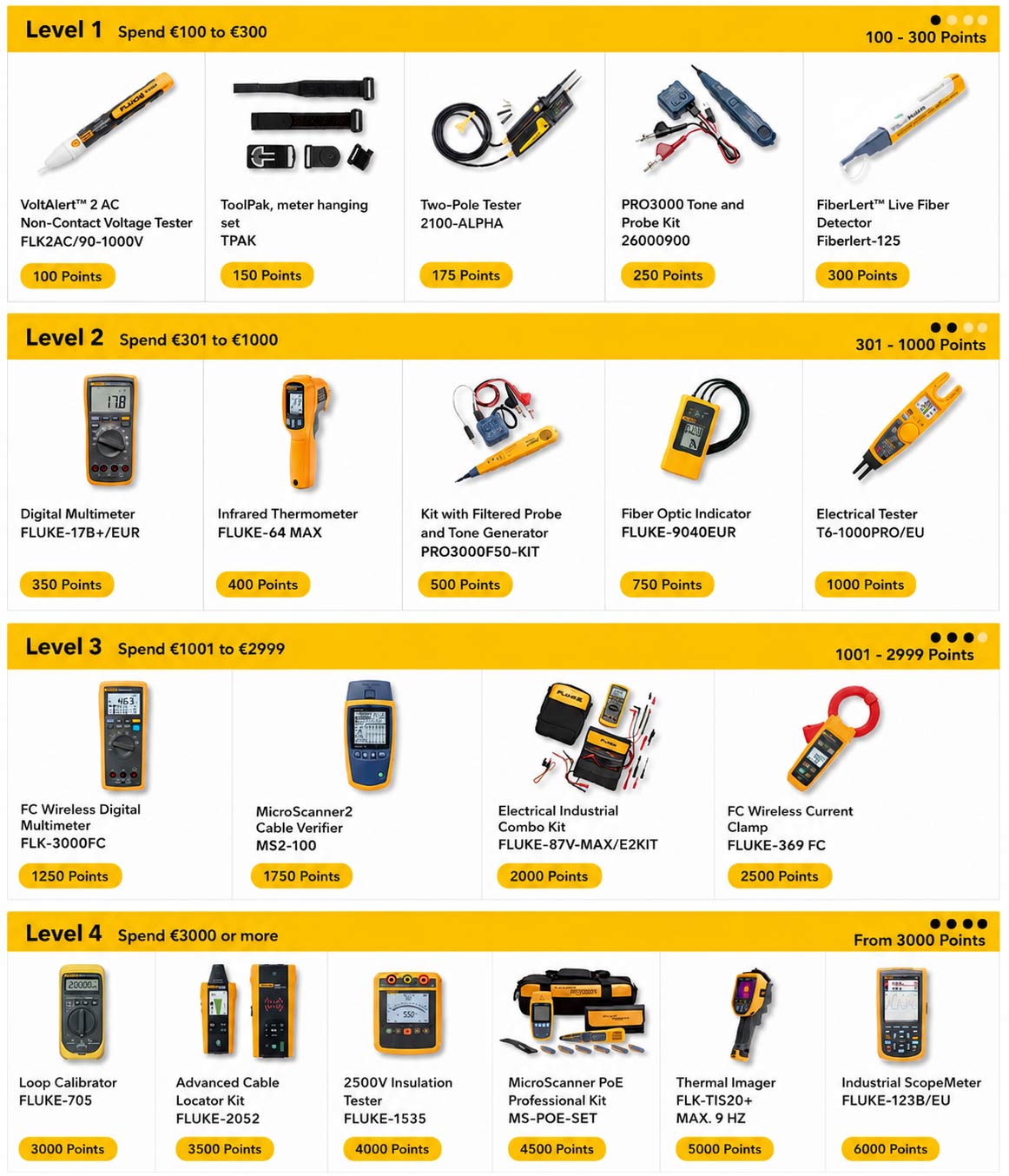
The more you spend, the greater the reward. See below which free Fluke instruments you can choose based on the number of points you have earned.
Determining the running speed of rotating equipment can be difficult, but the Fluke 820-2 LED strobe simplifies this process by allowing you to diagnose a stationary condition without stopping the machine, or coming into contact with it. For diagnosis of parasitic oscillation, slip or unwanted distortions, the 820-2 LED strobe is the ideal tool for on-site troubleshooting, process or product research and development.
For most applications, the standard flash duration works well without adjustments. Other applications with higher rpm or larger rotating objects with high surface speeds may require an adjustable flash duration. For high-speed applications, objects may move during the short period of a single flash, causing blurred images. By reducing the flash duration, objects have less time to move and the image becomes sharper.
The Fluke 820-2 LED strobe is more than just a tool for measuring the rotational speed of machines without physical contact. The device is also an excellent diagnostic tool for a variety of applications
In addition, the LED stroboscope can be used as a strobotachometer for measuring speed instead of a laser tachometer. To use the stroboscope, the component to be measured must be visible and have a mark that can serve as a reference point. A stroboscope tachometer is useful because you do not always have access to a machine shaft to put a piece of reflective tape on it that can be used by a laser tachometer; or you cannot make contact with the rotating shaft to use a contact tachometer. You can use a strobe to 'stop' the shaft to 30 TPM (FPM).
Our product specialists are happy to help with any questions about this range. Call, email or chat with us!
Chat with us
Click for more items in this promo.
Receive a free Fluke instrument when you purchase Fluke products! Valid from 01.09.2026 to 31.12.2026.
The more you spend, the greater the reward. See below which free Fluke instruments you can choose based on the number of points you have earned.